Plays from YouTube
Paradox of Voting
Why Vote When Your Vote Almost Never Decides?
- Paradoxes
- 56 s
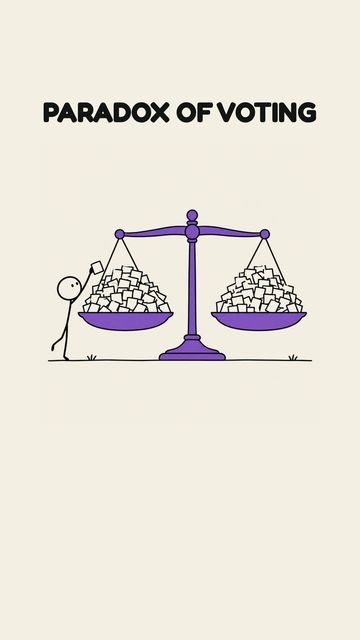
In the 2008 US presidential election, the average voter's chance of deciding the result was about 1 in 60 million, and voting costs time. Economist Anthony Downs saw the problem in 1957: for a purely selfish voter, voting doesn't pay. Yet about 130 million Americans voted. The way out: the stakes are shared by millions, many vote out of duty, and if nobody voted, one vote would decide everything.
Sources (3)
- Gelman, Silver & Edlin (2012), What Is the Probability Your Vote Will Make a Difference?, Economic Inquiry (opens in a new tab)
- Edlin, Gelman & Kaplan (2007), Voting as a Rational Choice, Rationality and Society (opens in a new tab)
- Stanford Encyclopedia of Philosophy, The Ethics of Voting (opens in a new tab)